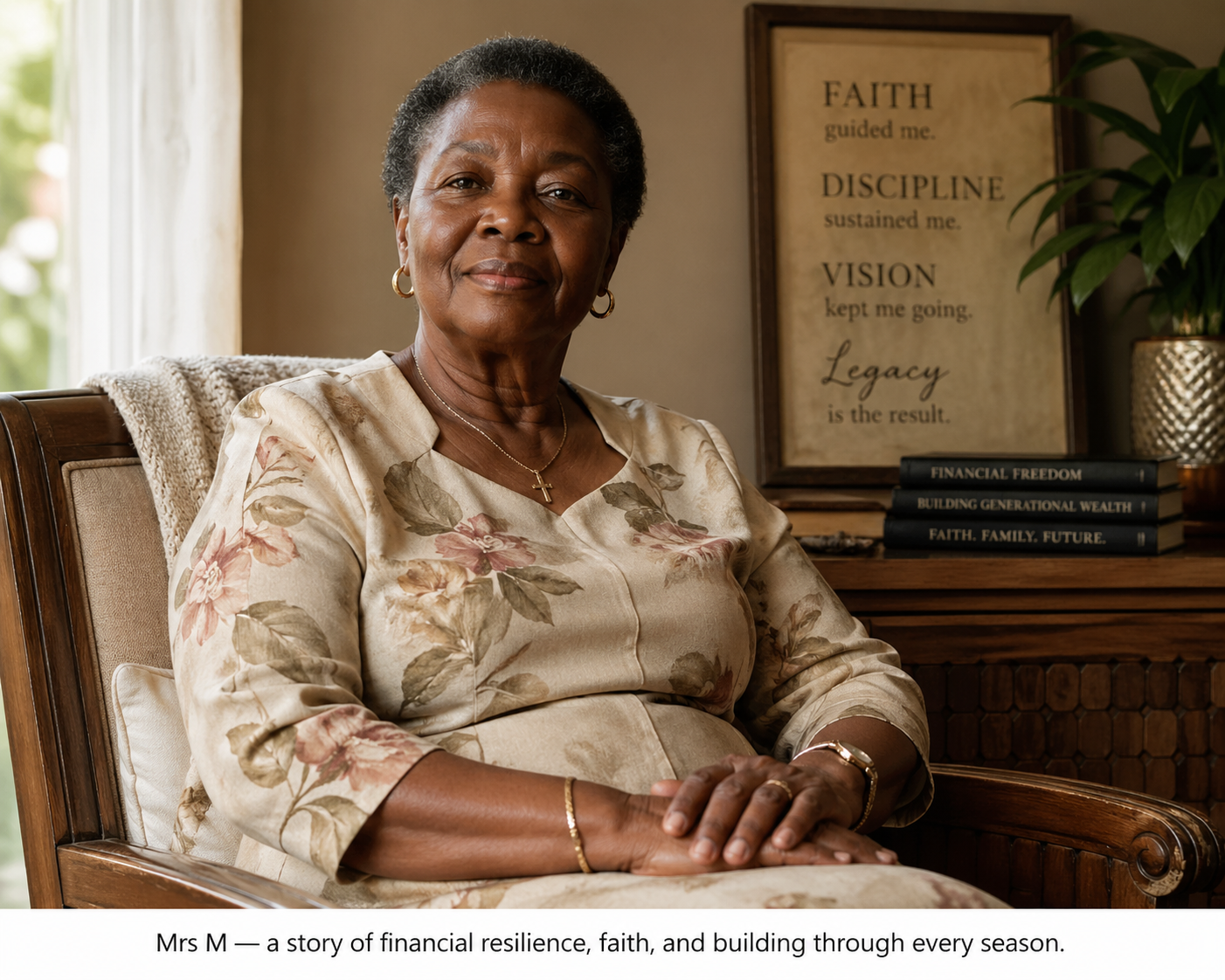
The Story of Mrs M — A Woman Who Used Every Tool She Had, Learned Everything She Did Not Know, and Refused to Stop
A supplementary read linked to Empty Jars, Open for Business · Elevate Finance Partners
Mrs M has requested to remain anonymous. The name used and any images accompanying this article are not her own. Her story is shared here with her full knowledge and blessing, in the hope that it reaches the woman who needs it most.
| The story in 2 Kings 4 is ancient. The widow who poured her oil into empty jars, paid her debts, and built her family into stability lived thousands of years ago. But her story is not as far away as it seems. Because women like her are still living — still pouring — still refusing to stop. This is the story of one of them. We will call her Mrs M. |
Mrs M is not a founder of a large company. She did not build a tech startup or launch a product that went viral. What she built was quieter than that — and in many ways, more remarkable. She built a family through crisis, on a government salary, in a season where most people would have folded. And she did it with the same tools the widow used: honesty about her situation, obedience to the next right step, and a refusal to let any single setback write the final chapter.
Her story is offered here not as a financial blueprint — but as a testimony. A mirror for every woman who is in the middle of something hard and wondering whether the pouring is worth continuing.
It is. Mrs M proves it.
January 2007: The Month Everything Changed
It was the start of a new year. Mrs M was a junior employee in her department — steady, committed, working far from her family to provide for them. She had five children: two in primary school, two just beginning their university journeys, and one navigating that uncertain space between studies and work.
Her husband had been the financial anchor of the family. He managed the accounts, the big payments, the long-term decisions. Finance, in the truest sense of the word, had been his domain. Mrs M knew her role. She played it faithfully. And the household worked.
Then in early January — before she could even return to work for the new year — her husband passed away.
In a single moment, the structure that had held everything together was gone. The income she had depended on was gone. The person who knew where every obligation sat, what was owed and to whom, what was coming and when — gone.
And she was left standing in front of a financial life she had never been the one to run, with five children depending on her to figure it out.
| “A father to the fatherless, a defender of widows, is God in His holy dwelling.” Psalm 68:5 (NIV) |
| “Your Maker is your husband — the Lord Almighty is His name.” Isaiah 54:5 (NIV) |
These were not just comforting words. They were a covenant covering that went ahead of her into every room she had never been in before — every bank, every creditor, every negotiation, every sleepless night she spent learning what she had never been taught.
| She did not have a finance degree. She did not have a roadmap. She had a family, a salary, and the quiet, terrifying necessity of learning — fast. And she had a God who had already declared Himself her provider. |
Learning Finance by Fire
There is a version of financial education that happens in classrooms and courses and carefully structured programmes. And then there is the version Mrs M received — delivered in real time, at high stakes, with no room for error.
She had to learn what accounts existed. What debts her husband had left. What the pension and group cover from his workplace would provide — and crucially, how far it would actually stretch. She had to learn how to negotiate. How to prioritise. How to hold the line on essential expenses while finding places to reduce pressure.
She used the pension she received to settle as many of her late husband’s debts as she could. That was the right instinct — reduce what you owe before you build anything else. But the pension did not stretch as far as the obligations demanded. She was not going to be able to close everything. So she made a decision that would require the kind of courage most of us never have to find: she kept going anyway.
| “By wisdom a house is built, and through understanding it is established; through knowledge its rooms are filled with rare and beautiful treasures.” Proverbs 24:3-4 (NIV) |
| There is a kind of financial education that no course can give you. It is the education of necessity — of having to understand something because the alternative is unthinkable. Mrs M received that education in full. And she graduated with honours. |
This is important to name clearly. Mrs M did not start this journey financially literate. She started it financially exposed. The literacy came through doing — through reading, asking, negotiating, making mistakes, adjusting, and doing it again. If you are a woman right now who feels like you do not know enough to manage your finances well — Mrs M’s story says you learn by starting. Not by waiting until you feel ready.
The Tough Calls That Love Requires
One of the hardest moments in Mrs M’s story is the one that came when the numbers simply would not stretch to cover her daughters’ university fees and accommodation costs. She had two daughters at university at the time. She had done everything she could to make it work. But the arithmetic was unforgiving.
So she made the call.
She brought both daughters home.
They were redirected to alternative higher education campuses — closer to home, significantly more affordable. The dream of the specific university did not survive the season. But the commitment to education did. Both daughters continued studying. The path changed. The destination did not.
| “In their hearts humans plan their course, but the Lord establishes their steps.” Proverbs 16:9 (NIV) |
| “For I know the plans I have for you, declares the Lord — plans to prosper you and not to harm you, plans to give you hope and a future.” Jeremiah 29:11 (NIV) |
The daughters’ detour was not a departure from God’s plan. It was a redirection within it. The destination — educated, established, capable women — remained unchanged. The road simply looked different than anyone had originally drawn it.
| Wisdom sometimes looks like pulling back in order to go further. The path Mrs M chose for her daughters was narrower — but it got them there. That is faithful stewardship under pressure. |
The Property That Was Not Yet Listed
After a year of renting, Mrs M reached a moment of clarity. She was spending a significant amount every month on rent — money that was building nothing, securing nothing, leaving nothing behind. She decided she needed something permanent. A home. Not just accommodation. A home for her children.
There was one significant problem: she did not qualify for the financing she would need.
And yet.
She found a property — one that had not yet been formally listed for sale. She found it before the market did. And when she sat across from the seller, she came prepared with something specific: a R200,000 deposit. That deposit reduced the outstanding amount she needed to finance to a level she could approach. It changed the conversation. It changed what was possible.
She secured the home.
| “The Lord makes firm the steps of the one who delights in Him.” Psalm 37:23 (NIV) |
| “The plans of the diligent lead to profit as surely as haste leads to poverty.” Proverbs 21:5 (NIV) |
| She found the property by grace — before it was even on offer. That is not a coincidence I will explain away. That is the kind of thing that happens when a woman is moving in obedience, doing the next right thing, and trusting that the God who sees her crisis is also ordering her steps. |
There are two things in this moment worth holding together. First: the grace. The property found before it was listed. The door opened before she knocked. That is real and it matters and it is worth acknowledging. But second: the preparation. She had a deposit. She had not arrived at that negotiating table empty-handed. The grace met her preparation — and together they secured the home.
Your preparation is never wasted. Even when it looks like nothing is happening, what you are building in the quiet is positioning you for the door that is about to open.
When the Fire Came
Mrs M also had a property in another province. A home she and her husband had built together. One of the assets they had created as a couple — his legacy in bricks and mortar, still standing after he was gone. She had been renting it out — using that income to supplement her salary and keep the household moving forward. It was a lifeline. One of the jars he had left her to pour from.
Then the tenants burnt it down.
And when she went to the insurance — the institution she had paid into, the safety net she had trusted — they refused the claim. The reason: the property had not been declared as a rental property on the policy. A technicality. A devastating one.
She lost the income. She lost the structure. She was not able to rebuild. The financial blow landed on top of everything else she was already carrying.
| “The Lord gave and the Lord has taken away; may the name of the Lord be praised.” Job 1:21 (NIV) |
| “And we know that in all things God works for the good of those who love Him, who have been called according to His purpose.” Romans 8:28 (NIV) |
| And she kept the land. |
That detail — she kept the land — is one of the most quietly powerful things in this entire story. She could not rebuild. The resources were not there. But she held onto what remained. She did not sell in despair. She did not let the loss erase what had once been an asset simply because it was no longer generating income. She kept it. And in keeping it, she preserved the possibility of something future she could not yet see.
There is a lesson here for every woman who has experienced a financial loss that insurance, systems, or people failed to protect. Sometimes you cannot rebuild immediately. Sometimes all you can do is hold the ground you have. That is not nothing. That is stewardship of what remains. And it matters.
Also — and this is said gently because it is genuinely important — Mrs M’s experience with the insurance refusal is a real and costly example of why declaration matters. Rental income must be declared. Policies must reflect actual usage. The financial systems we rely on have terms — and those terms exist whether or not we have read them. Consumer education is not just empowerment. It is protection.
Borrowing With Purpose, Not Panic
Mrs M used credit. Let us be clear and honest about that because it is part of what makes her story real and useful to the women reading this.
She borrowed from the bank. She borrowed from neighbours. She used debt as a tool to keep her children’s education moving when her income alone could not carry the weight.
| “The rich rule over the poor, and the borrower is slave to the lender.” Proverbs 22:7 (NIV) |
Mrs M knew the weight of that verse — not as a theological concept, but as lived experience. Debt is a master when it is unmanaged. She did not pretend otherwise. She carried her obligations with full awareness of what they cost her — in stress, in sleepless nights, in the years of margin they consumed. But she also carried them with purpose. The debt was not funding a lifestyle. It was funding a generation.
| “The plans of the diligent lead to profit as surely as haste leads to poverty.” Proverbs 21:5 (NIV) |
| Mrs M’s use of credit was not reckless. It was intentional and it was sacrificial. She was not borrowing to fund a lifestyle. She was borrowing to fund a generation. That distinction matters — both morally and financially. |
The Family That Carried Itself
One of the most beautiful threads in Mrs M’s story is what happened within the family as the children grew.
Her eldest — once through and established — stepped in. Not asked, not obligated, but present. Helping with expenses. Contributing to the cost of a younger sibling’s further studies. Taking on some of the weight their mother had been carrying alone.
Her other children, though they struggled to find work immediately after completing their studies, persevered. They did not give up. They kept trying. And eventually — as perseverance tends to do when it does not quit — they found their footing.
| “Start children off on the way they should go, and even when they are old they will not turn from it.” Proverbs 22:6 (NIV) |
| What you pour into your children in a season of sacrifice does not return void. It returns — in character, in resilience, in the quiet way they show up for you and for each other when the time comes. |
Retirement: The Account That Tells the Whole Story
Mrs M reached retirement. And at retirement she did something that deserves to be said slowly and clearly:
She took her pension and she settled every debt she had accumulated over the years.
Every rand borrowed from the bank. Every obligation she had carried through sleepless nights and tight months and seasons where the arithmetic simply did not work. She closed them. All of them.
She has no debt.
She has a home — a home her children can come back to, a home that exists because of a deposit negotiated before a property was even listed, a home that represents one of the most determined financial decisions made under the most difficult circumstances.
And then this — the detail that stops you completely when you hear it:
She now has more investments than her husband had at the time of his death.
Her husband had carried the financial load faithfully. He had built what he could — and the pension and group benefits from his employer were the foundation he left behind. It was a starting point. A real one. And she honoured it by building further on top of it.
She took what he had started and built it further. Through crisis. Over years.
| “Those who sow with tears will reap with songs of joy. Those who go out weeping, carrying seed to sow, will return with songs of joy, carrying sheaves with them.” Psalm 126:5-6 (NIV) |
| She honoured what her husband built and then she built beyond it. Through more than most of us will ever face. And she finished with more than she began. That is not luck. That is obedience compounding over time. |
What Mrs M Teaches Us
I want to draw the threads of her story together — not to reduce it to a list, but to name the principles clearly so that every woman reading this can carry something specific forward.
1. You do not have to know everything before you start
Mrs M did not start this journey financially literate. She started it financially exposed. The knowledge came through necessity, through doing, through asking the right questions even when she did not know what she did not know. You do not need a full map. You need the courage to take the next step.
2. Debt is a tool — use it with intention
She used credit. Purposefully. Directed toward education and necessity, not lifestyle. She did not avoid debt out of fear. She used it strategically, carried it responsibly, and closed it faithfully. That is the right relationship with credit.
3. Sometimes the path changes, but the destination does not
Her daughters did not finish at the universities they started at. The route changed. But the commitment to their education did not waver. When life forces a detour, the question is not whether the original path still exists. The question is whether you are still moving toward the destination.
4. Keep the land
When the property burnt down and the insurance failed her, she could not rebuild. But she kept the ground. She preserved the asset even when it was not generating anything. Holding what you have in a season of loss is a valid and wise form of stewardship.
5. Grace finds you when you are moving
The property that was not yet listed. The door that opened before she formally knocked. These are the moments that happen to women who are in motion — who are doing the next right thing, making the next wise decision, trusting that what they cannot see is still being ordered. Mrs M was moving. The grace met her there.
6. What you pour into people compounds
Her investment in her children’s education — financially costly, emotionally demanding, relentlessly sustained — did not just change their lives. It created a family that carries itself. Her eldest stepped in. Her daughters persevered. Her son completed his studies. The return on the investment Mrs M made in her people outlasted every financial challenge she faced.
7. Close what you owe before you rest
At retirement she settled her debts before she settled into her season of rest. That ordering — obligation before ease — is the mark of a woman who understands what financial peace actually requires. Debt freedom is not given. It is built toward, one decision at a time.
A Final Word
Mrs M did not set out to be an example. She set out to raise her children. To honour the life she and her husband had built together. To keep going when the only honest reason she had for continuing was that stopping was not an option.
She is not extraordinary in the way the world uses that word. She did not make headlines. She did not build a company with a logo and a social media following. She built something quieter and more durable than that.
She built a family that came out the other side.
And she built herself — into a woman who, at retirement, carries no debt, owns her home, holds her land, and has more than she started with.
If you are reading this in the middle of your crisis — in your January 2007, in your season of fire, in the year where the arithmetic just will not work — I want you to hear this clearly:
| “Let us not become weary in doing good, for at the proper time we will reap a harvest if we do not give up.” Galatians 6:9 (NIV) |
| You do not have to see the whole road. You just have to take the next step. Mrs M took hers. Faithfully. Repeatedly. Over years. And she made it to a retirement that tells the whole story — not of what she lost, but of what she built despite it. |
Keep pouring, sis. The jars are filling — even when you cannot see it yet.
A Note on the Financial Lessons in This Story
Mrs M’s story carries several practical financial principles worth naming explicitly for educational purposes:
- Pension and death benefits: understand exactly what workplace cover provides — and more importantly, what it does not. Life cover beyond group benefits is a critical gap many families discover too late.
- Deposit strategy: a significant deposit does not just reduce your loan amount — it can make the difference between qualifying and not qualifying for financing. Building a deposit is a strategic priority, not just a savings exercise.
- Rental declaration: if you rent out a property, it must be declared on your insurance policy. Failure to do so can invalidate a claim entirely — as Mrs M experienced at enormous personal cost.
- Debt with a plan: borrowing to fund education or necessity is not inherently wrong. What matters is that the debt is purposeful, that you understand the obligations, and that you have a realistic path to repayment.
- Debt settlement at life transitions: using lump-sum payments — such as retirement payouts — to clear accumulated debt is one of the most powerful financial resets available. Mrs M used her retirement payout exactly this way.
| This story is shared for educational and inspirational purposes. It is not financial advice. Every situation is unique. If you are navigating financial complexity — debt, property, insurance, or retirement planning — a Clarity Session with Nomzamo is a good first step to help you understand your situation and ask the right questions. For advice specific to your personal circumstances, please consult a qualified financial professional. |
Mrs M Built With What She Had. So Can You.
Mrs M did not have multiple income streams when January 2007 arrived. She had a salary, a pension, and the fierce necessity to make it enough. One of the greatest vulnerabilities her story reveals is what happens when a single source of income is all that stands between a family and crisis.
You may not be in crisis right now. But Mrs M’s story is a quiet invitation to ask yourself: if everything changed tomorrow — what income would remain?
The Elevate Income Accelerator was built for exactly this question. Not to work harder. But to build additional streams — intentionally, faithfully, sustainably — so that your family’s financial foundation rests on more than one pillar.
Your skills, your story, your experience — that is your jar of oil. The EIA gives you the container to turn it into income.
EIA Foundations — R99 From zero to live digital business in your first week.
EIA Growth Track — R299 Build your brand, content system, and first passive income streams.
EIA Professional — R599 SEO, YouTube, email marketing — income that finds you.
EIA Executive — R999 Your complete business system. Including 1-on-1 mentoring.
Visit payhip.com/ElevateFinancePartners or WhatsApp me on 073 509 8750. I reply personally to every message.
And for the Little Ones Watching You Build —
Mrs M learned finance by fire — in crisis, with children depending on her to figure it out.
myKidpreneur exists so that your children never have to.
Your children are watching you build right now. They are absorbing your relationship with money — your language around it, your confidence with it, your willingness to talk about it. myKidpreneur gives them something structured to grow into: the mindset, the vocabulary, and the early entrepreneurial foundation that turns financially curious children into financially capable adults.
| The widow built for her sons. Mrs M built for her children. You are building for yours. Give them the head start neither woman had — and watch what they do with it. |
myKidpreneur Financial literacy and entrepreneurship education for children — because the best time to teach your child about money is before they need to know.
Ask me about myKidpreneur on WhatsApp: 073 509 8750 or visit https://beacons.ai/thriven for more.
This piece is a supplementary read linked to:
Empty Jars, Open for Business — The Widow Had Nothing. Except Everything She Needed. Then She Built.
Read the main blog post at elevatefinancepartners.online
Blessings & Abundance,
Nomzamo
Elevate Finance Partners · Reduce what you owe. Grow what you own.
The content shared on Elevate Finance Partners is intended for general educational and informational purposes only. It does not constitute financial, legal, or investment advice. If you are navigating financial complexity and need a guided starting point, a Clarity Session with Nomzamo can help you understand your options and ask the right questions. For advice specific to your personal financial situation, please consult a qualified financial professional. The story of Mrs M is shared with full consent and has been kept anonymous to protect privacy.
Leave a Reply