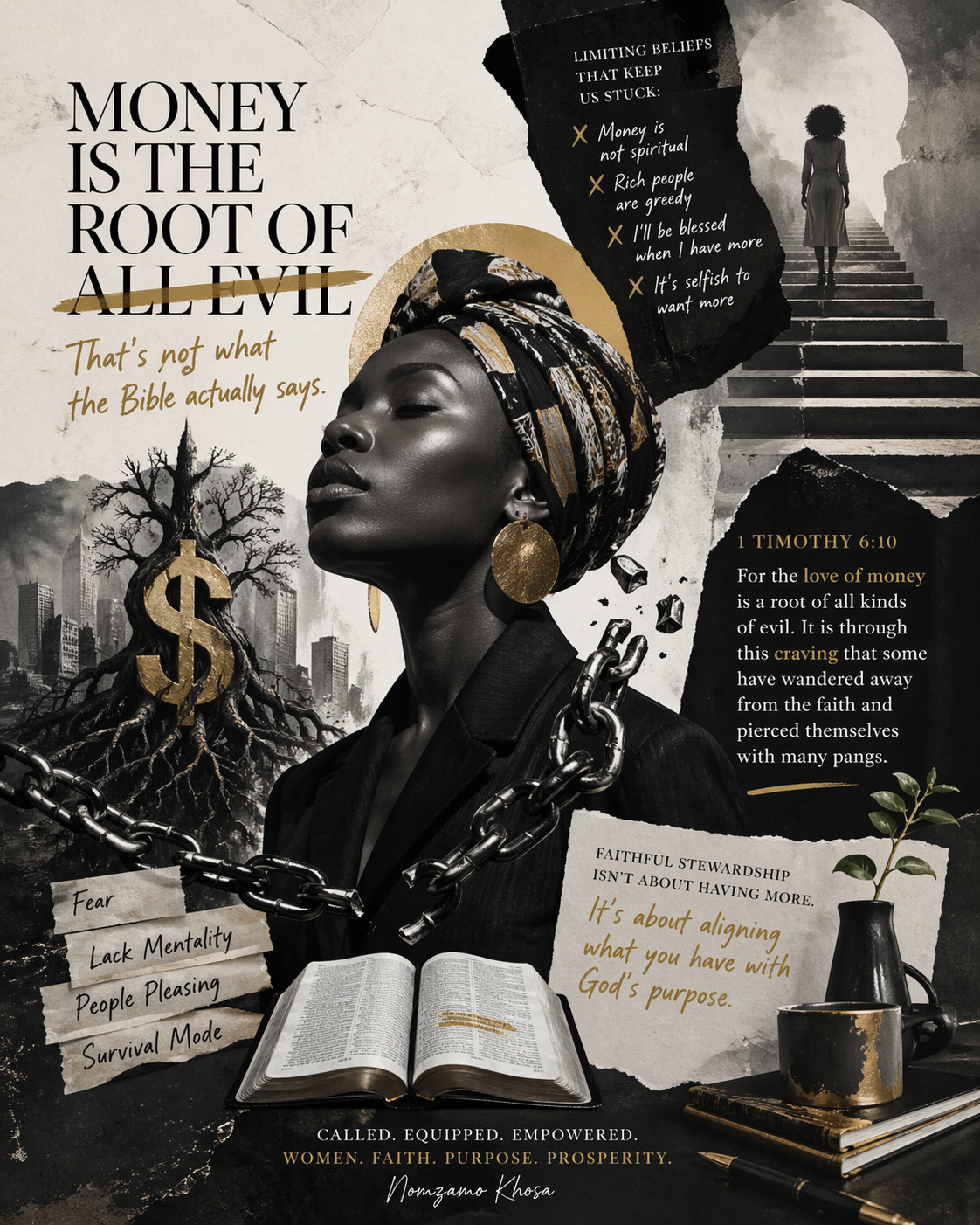
Unriddling “Money is the Root of All Evil” — and What It Means for the Woman Walking in Her Entrepreneurial Calling
Nomzamo Khosa · Elevate Finance Partners
| Sis, can I tell you something that might set a few things free in you today? You have probably said it, heard it, or had someone say it to you at church, at the dinner table, maybe even inside your own head when you started dreaming bigger. “Money is the root of all evil.” And somewhere along the way, you took that in. You carried it. Maybe it even quietly convinced you that wanting financial growth was not spiritual. That being broke was somehow humbler. That a woman of faith should not want too much. I am here today, with my 14 years of finance experience and everything God has taught me through it, to tell you — that belief is costing you more than you know. And it is not even what the Bible says. |
Let us sit down together and unriddle this one properly. Because the truth on the other side of this misquote is not just educational — it is liberating.
Section 1: The Misquote That Has Kept Believers Bound
Every generation passes it down. Voices we trusted have quoted it. Parents have said it at the table. Friends have whispered it when someone starts doing well. But here is what 1 Timothy 6:10 actually says:
| “For the love of money is a root of all kinds of evil. Some people, eager for money, have wandered from the faith and pierced themselves with many griefs.” 1 Timothy 6:10 (NIV) |
Did you catch it? It is not money that is the root of evil. It is the love of money. One word — one tiny, significant word — changes everything.
The original Greek text uses the word philarguria. Philos means love. Arguros means silver. It is a compound word describing an obsession — a disordered attachment — to money. Not the possession of it. Not the building of it. The worship of it. The making of it your master instead of your servant.
God never once said money is evil. He said the idolisation of it — the placing of it above Him, above people, above integrity — is where destruction begins. That is an entirely different conversation than the one most of us have been having.
| A quick note before we continue: Everything I share here is for educational purposes. I am a consumer educator — not a financial advisor. Always consult a qualified professional for advice specific to your situation. |
Section 2: What the Bible Actually Says About Money
Here is what surprises most people when they actually open the Book: the Bible talks about money more than almost any other subject. And the overwhelming message is not avoidance. It is stewardship, wisdom, and multiplication.
God gives us the ability to create wealth
| “But remember the Lord your God, for it is He who gives you the ability to produce wealth, and so confirms His covenant.” Deuteronomy 8:18 |
God does not give you the ability to produce wealth as a trap. He gives it as confirmation of covenant. Wealth creation, done faithfully, is an act of alignment with God’s purpose over your life.
A good person plans generationally
| “A good person leaves an inheritance for their children’s children.” Proverbs 13:22 |
You cannot leave an inheritance if you have avoided money your whole life. Generational wealth is not a worldly concept — it is a biblical mandate.
Faithfulness with money is a spiritual test
| “So if you have not been trustworthy in handling worldly wealth, who will trust you with true riches?” Luke 16:11 |
Jesus himself linked financial faithfulness with spiritual trustworthiness. How you handle money is a reflection of your stewardship character. It matters to God.
God expects a return on what He deposits in you
The Parable of the Talents in Matthew 25 is one of the most striking passages in all of scripture on this subject. Three servants were each given a sum. Two multiplied what they received. One buried his out of fear. The ones who grew what they were given were praised. The one who buried it — out of caution, out of timidity — was rebuked.
This is a picture of our call. God does not celebrate financial paralysis. He celebrates multiplication.
The blessing of the Lord brings wealth
| “The blessing of the Lord brings wealth, without painful toil for it.” Proverbs 10:22 |
Section 3: The Limiting Beliefs That Keep Believers in Bondage
This is where I need to be honest with you — and I say this with love, because I have lived inside some of these beliefs myself.
When a misquote becomes a cultural narrative, it plants seeds that grow into full-grown limitations. And for believers — especially women of faith in South Africa — these limiting beliefs run deep. Let us name them.
Limiting Belief 1: Wanting money means I am greedy
Wanting to pay your rent without stress is not greed. Wanting to send your children to a good school is not greed. Wanting to build a business that creates jobs in your community is not greed. Greed is the disordered love of money — wanting it above all else, at the expense of others, in place of God. Wanting financial stability is wisdom. There is a world of difference between the two.
Limiting Belief 2: Being poor is more spiritual
There is a version of this belief so embedded in church culture that it is almost invisible. The idea that scarcity is a sign of spiritual purity. That the woman who struggles the most must love God the most. But poverty is not a fruit of the Spirit. And choosing to stay financially ignorant is not an act of faith — it is an act of fear dressed up as humility.
I once heard someone say something that stopped me in my tracks: “You are not humble, you are just poor”. It was sharp. It was uncomfortable. And it carried a truth that I think many of us need to sit with. True humility is not about lack. True humility is about submitting your resources — however big or small — to God’s purposes. You can be deeply humble and financially flourishing. These are not opposites.
Limiting Belief 3: Rich people must have done something wrong
This one quietly poisons community. When we assume that any woman building wealth must have compromised somewhere — must have cut a corner, exploited someone, made a deal with the wrong spirit — we make prosperity suspicious by default. And then we are afraid to build it ourselves, lest we become the person we are quietly judging.
Wealth is not automatic evidence of corruption. It is evidence of what it has always been: strategy, consistency, and stewardship — whether done with faith or without it.
Limiting Belief 4: I should not talk about money
In many households, especially in our culture, money is not discussed. It is a private, even shameful subject. So women grow up not knowing how interest works. Not understanding what a credit score does. Not knowing that the NCA gives you rights as a consumer. Not realising that their vehicle finance contract has a balloon payment that will ambush them in three years.
Silence about money does not protect us. It leaves us vulnerable to systems that are not designed with our flourishing in mind.
Limiting Belief 5: God will provide — so I do not need to plan
Yes. God provides. The Word is full of it. But provision and planning are not opposites in scripture — they are partners. Proverbs 21:5 says the plans of the diligent lead to profit. God provides the seed. He does not plant it, water it, and harvest it for you. He calls you to do that part. Faith without action, as James 2:26 reminds us, is dead.
| Every one of these limiting beliefs has a cost. The cost is not just financial — it is generational. The belief you carry today shapes what your children are taught tomorrow. Breaking the cycle starts in your mind, before it ever shows up in your bank account. |
Section 4: Money Reveals Character — It Does Not Create It
There is a principle that does not get nearly enough airtime, and it is this: money is a magnifier. It does not change who you are. It reveals who you already are.
Give a generous person more money, and they give more. Give a fearful person more money, and they hoard more. Give a compassionate person more resources, and they build more capacity to serve. Give a dishonest person more opportunity, and their dishonesty simply operates at a larger scale.
This is why the pursuit of wealth without a parallel pursuit of character development is genuinely dangerous. The verse in 1 Timothy is not warning us against money — it is warning us to examine our hearts before money becomes a test we fail.
| “Above all else, guard your heart, for everything you do flows from it.” Proverbs 4:23 |
The woman who builds her business with integrity — who treats her clients with dignity, pays her taxes, tells the truth in her marketing, and honours God in her financial decisions — that woman can be trusted with increase. Because the character was built before the money arrived.
And conversely: someone can appear humble and content in their poverty, while carrying envy, bitterness, and resentment toward anyone who is building. That is not spiritual wealth. That is lack of both kinds.
I want us to be women who are rich in both. Build the internal life. Build the financial life. Let neither one lag behind the other.
| A person of true character looks the same in abundance as they do in scarcity. That is the goal. Not to wait for money to reveal your character — but to build your character so thoroughly that money simply confirms it. |
Section 5: The Solopreneur Woman Walking in Her God-Given Calling — Your Stance
Let me speak directly to you now. The woman who started a business from her kitchen table, from her phone, from a dream she has been too afraid to say out loud. The woman who is building something while still holding down a job, still raising children, still figuring it out. The woman who hears the call on her life and is learning — sometimes imperfectly — how to answer it.
Here is your stance. Write it somewhere.
1. Building wealth is part of your assignment
You are not here accidentally. The calling you carry — to build, to create, to serve, to generate — is not separate from your faith. It is an expression of it. Ephesians 2:10 says you are God’s handiwork, created in Christ Jesus to do good works, which God prepared in advance for you to do. Your business is good work. Your income is the fruit of good work. Own that.
2. You are a steward, not an owner
Everything you earn, build, and accumulate ultimately belongs to God. This is not a limitation — it is a liberation. When you understand that you are managing His resources on His behalf, the anxiety around money shifts. You stop making decisions from fear and start making them from trust. You ask: what is the wisest steward’s decision here? Not: what makes me feel safe?
3. Your income is your ministry budget
The more you build, the more you can give. The more you earn, the more you can invest in your community, your family, your calling, your church, the causes that break your heart. Wealth in the hands of a faithful woman is not a threat to the kingdom — it is a resource for it.
4. Financial education is an act of obedience
We do not honour God by staying financially ignorant. We honour Him by learning how money works, making wise decisions with what we have, and teaching our children to do the same. Proverbs 24:3-4 says: By wisdom a house is built, and through understanding it is established; through knowledge its rooms are filled with rare and beautiful treasures. Wisdom. Understanding. Knowledge. These are required.
5. You are allowed to charge what you are worth
This one needs its own moment. Many women of faith undercharge chronically. They feel that taking money for their gift is somehow less spiritual. That they should give it away, discount it, make it accessible to everyone at their own expense. Sis, the worker deserves her wages (1 Timothy 5:18). Charging well for genuine value is not greed. It is self-respect, sustainability, and the foundation of a business that can keep giving for the long term.
| “The plans of the diligent lead to profit as surely as haste leads to poverty.” Proverbs 21:5 |
Section 6: How Solopreneurs and Women of Faith Should Govern Their Finances
This is the practical section. Faith without financial strategy leaves good intentions on the floor. Here is how to govern your finances as a woman walking in purpose.
Principle 1: Separate your money — every rand has an assignment
From the day you earn your first business rand, give it a category. One account for business income, one for personal, one for tax, one for growth. When everything lives in one account, nothing has accountability. Create the structure before you think you need it, not after the chaos starts.
Principle 2: Tithe from your business income
This is personal conviction, not a rule. But many women of faith find that honouring God first — from their business income just as from their salary — creates a different quality of stewardship over everything that remains. You are acknowledging that the source is not you.
Principle 3: Build before you spend
The order matters: Save first. Invest second. Spend third. Most of us were taught the reverse — spend, and save whatever is left. There is almost never anything left. Pay yourself first. Pay your savings account, your TFSA, your emergency fund — before you buy anything that is not essential. Then spend what remains with peace.
Principle 4: Know your numbers without apology
Know your monthly revenue target. Know your break-even point. Know your tax obligations. Know what your profit margin is per product or service. Financial intelligence is not unfeminine. It is not unspiritual. It is what responsible stewardship requires. If your numbers make you nervous, that is not a reason to look away — it is the most urgent reason to look closer.
Principle 5: Protect what you build
This means having appropriate insurance. It means not lending money that would collapse your emergency fund. It means not going surety for someone else’s business debt without understanding exactly what you are signing. It means building a legal structure — even a simple one — that separates your personal assets from your business risk. Protection is not distrust. It is wisdom.
Principle 6: Pay off debt with the same energy you build income
Debt is a thief of margin and peace. Every rand you pay in interest is a rand that cannot be invested, cannot be given, cannot be used for the purpose God is growing you toward. Make a plan, work the plan, celebrate the milestones, and close those accounts one by one. Reduce what you owe. Grow what you own. Our tagline is not just branding — it is a financial strategy.
Principle 7: Create income streams, not just a salary
A solopreneur who earns from only one source is one setback away from financial crisis. Build multiple streams — even small ones to begin with. A digital product. An affiliate link. A service tier. A retainer. Diversification is not lack of focus. It is mature financial architecture.
| Financial governance is not a once-off event — it is a weekly practice. Set a money date with yourself. Review your income. Track your expenses. Adjust your plan. The women who build generational wealth are not the ones who earn the most — they are the ones who are most intentional with what they earn. |
Section 7: What Faithful Financial Stewardship Actually Looks Like
I want to close this section with a picture. Not a formula. A picture.
It looks like the woman who tithes on her first invoice, even when it feels too small to matter. It looks like the woman who saves R500 before she buys anything extra, even when she wants to. It looks like the woman who charges her full rate, not the discounted one she offers out of insecurity. It looks like the woman who sits down every Sunday evening and knows exactly where every rand is going that week.
It looks like the woman who builds an emergency fund instead of relying on credit cards in a crisis. Who opens a TFSA for her child before they are old enough to understand what one is. Who refuses to co-sign for someone else’s unwise decision, even when the pressure is real. Who teaches her daughter that wanting financial independence is not worldly — it is wise.
It looks like integrity in the small things, long before the big things arrive.
| “Whoever can be trusted with very little can also be trusted with much.” Luke 16:10 |
The size of your income right now is not the point. The faithfulness of your stewardship — in this season, at this income level, with these resources — is what builds the foundation for the next level. God is not waiting for you to earn more before He can trust you. He is watching what you do with what you have right now.
Ready to Build With Intention?
You don’t need more motivation.
You need structure, strategy, and support.
That’s exactly what the Elevate Income Accelerator was built for.
The Elevate Income Accelerator (EIA) was built for exactly this woman. The woman who is ready to stop hiding from money and start building something real with it. From R99, you can access a complete digital business education — faith-grounded, practically built, designed for South African women who are done waiting to be ready.
EIA Foundations — R99 · Your first step. From zero to live digital business in a week.
EIA Growth Track — R299 · Build your brand, content system, and first passive income streams.
EIA Professional — R599 · SEO, YouTube, email marketing — income that finds you.
EIA Executive — R999 · Your complete business system. Including 1-on-1 mentoring.
Start where you are. Build as you grow. But don’t stay stuck. Visit payhip.com/ElevateFinancePartners or WhatsApp me on 073 509 8750. I respond personally to every message.
Money is not your enemy. The love of it — above God, above people, above your own integrity — that is where the danger lives. But money in the hands of a faithful, purpose-driven woman? That is a resource for the kingdom. That is generational legacy. That is the fruit of stewardship done well.
Go build. Build wisely. Build with integrity. Build for the generation that is watching you.
If you’ve ever felt guilty for wanting more — not more things, but more stability, more impact, more freedom — this is your permission to stop shrinking what God has called you to build.
Blessings & Abundance,
Nomzamo
Elevate Finance Partners · Reduce what you owe. Grow what you own.
Leave a Reply