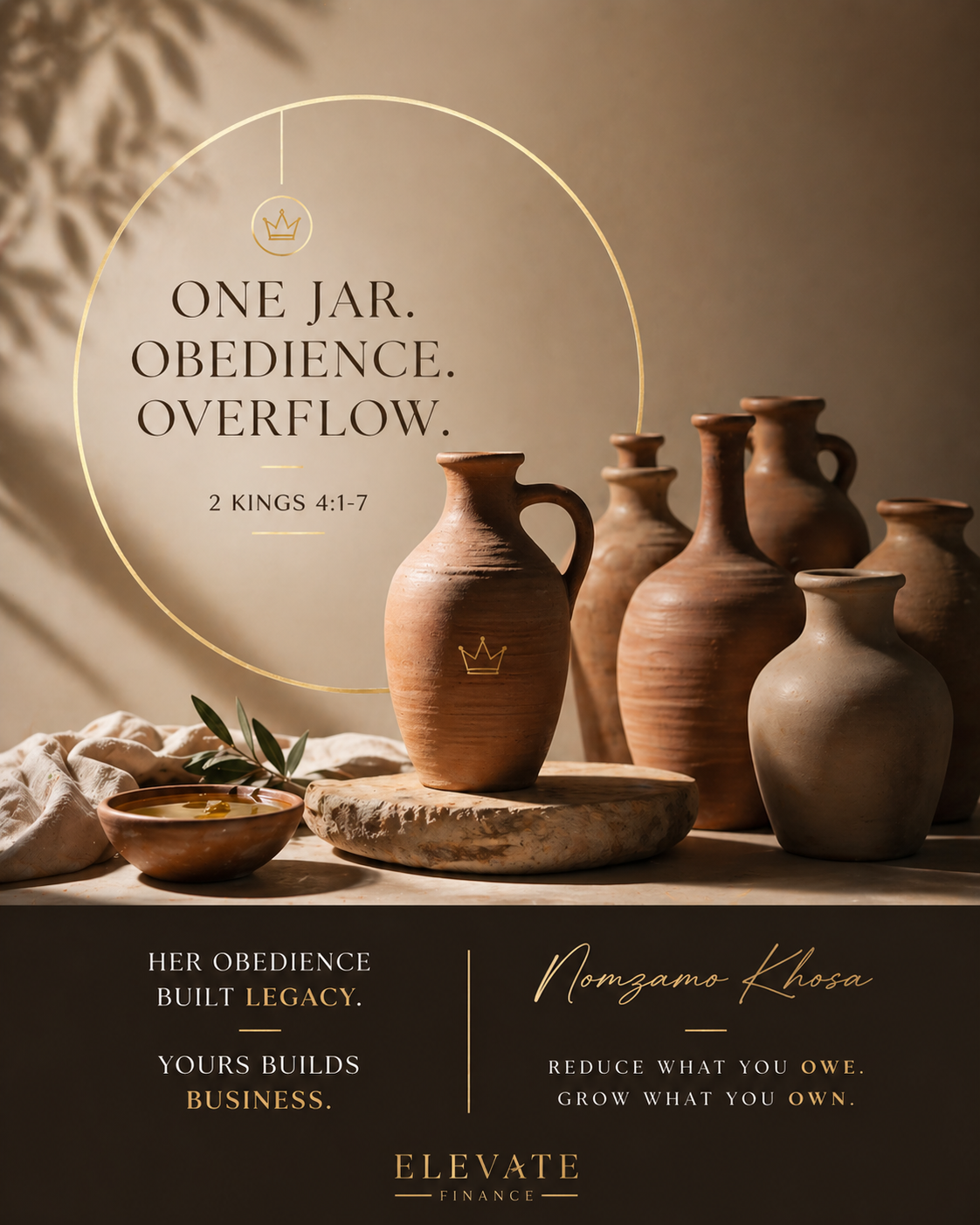
The Widow Had Nothing. Except Everything She Needed. Then She Built.
Nomzamo Khosa · Elevate Finance Partners
| Last week we sat together and unriddled one of the most misquoted scriptures in history — that money is not the root of all evil, but the love of it. And something shifted. This week I want to walk alongside you a little further. Because knowing that money is not evil is just the beginning. The real question is: what do you do when you are standing in your crisis, looking at what feels like nothing, and you still have a calling to build? Sis, I want to introduce you to a woman who answered that question — thousands of years before any of us were born. And her story is so relevant to the woman building today that it almost takes your breath away. |
Her name is not recorded in scripture. We know her only as the widow. But what she did with her empty jars changed everything for her family — and it has something important to say to every woman walking in her God-given entrepreneurial calling today.
Section 1: The Story — 2 Kings 4:1–7
Before we apply it, let us sit inside it. Read it slowly.
| “The wife of a man from the company of the prophets cried out to Elisha: Your servant my husband is dead, and you know that he revered the Lord. But now his creditor is coming to take my two boys as his slaves. Elisha replied to her: How can I help you? Tell me, what do you have in your house? Your servant has nothing there at all, she said, except a small jar of olive oil. Elisha said: Go around and ask all your neighbours for empty jars — don’t ask for just a few. Then go inside and shut the door behind you and your sons. Pour oil into all the jars, and as each is filled, put it to one side. She left him and shut the door behind her and her sons. They brought the jars to her and she kept pouring. When all the jars were full, she said to her son: Bring me another one. But he replied: There is not a jar left. Then the oil stopped flowing. She went and told the man of God, and he said: Go, sell the oil and pay your debts. You and your sons can live on what is left.” 2 Kings 4:1–7 (NIV) |
Take a moment with that. A woman in crisis. Debt so severe it threatened her children’s freedom. A single asset she almost dismissed as nothing. A strategy she did not design herself. An act of obedience in private. And a result that paid her debts and left enough to live on.
That is not just a miracle story. That is a business model.
Section 2: She Identified Her Crisis — and She Named It
The first thing the widow did was not pray and wait. She went to Elisha and she named exactly what was happening.
My husband is dead. We are in debt. The creditor is coming. My children are at risk.
She did not minimise it. She did not spiritualise it into a vague request. She walked into the right room and said: this is my situation, and I need help.
I want to pause here with you because this step — the step of honest identification — is one that so many women skip. We carry the weight of a financial crisis in silence. We feel shame about the debt. We are embarrassed about the empty account. We dress the struggle in spiritual language and hope God fills in the blanks without us having to say it out loud.
But the widow named it. Clearly. Specifically. To the right person.
| There is something powerful about naming your crisis accurately. Not to sit in it — but to move through it. You cannot solve a problem you are too afraid to define. The widow’s courage to say exactly where she stood is what opened the door to the strategy that followed. |
For the woman building today: where are you right now — really? Not the version you post. Not the polished pitch. The actual financial reality. Name it. Not in shame. In honesty. Because clarity is the first step toward strategy.
Section 3: She Cried to the Right Person
Notice where the widow went. Not to her neighbours to borrow money. Not to social media to air her situation. Not to the person most likely to judge or gossip. She went to Elisha — a man of God, a prophet, someone with both wisdom and access to divine direction.
She cried to the right person.
This principle is so quietly important in the season of building a business. Not every person deserves your vulnerability. Not every table deserves your vision. Not every relationship is equipped to carry what you are building. The widow chose her counsel wisely — and the strategy she received came directly from that choice.
For the solopreneur woman: who are you crying to? Who are you taking your business challenges, your financial confusion, your next-step uncertainty to? Are they the right person? Do they have the wisdom, the experience, the faith-grounded perspective to give you something useful — or are they simply available?
| Proximity to the right counsel is a business asset. Do not underestimate who you allow to speak into your building season. |
And there is another layer here. The widow went to Elisha — but behind Elisha was God. She was ultimately taking her cry to the source of all wisdom and provision. In your building season, there is no strategy meeting more important than the one you have on your knees. Business prayer is not a nice addition to your morning routine. It is the foundation of building that lasts.
Section 4: She Took Inventory — “What Do You Have in Your House?”
This is the question that changes everything. Elisha did not ask her what she needed. He asked her what she had.
What do you have in your house?
And her first answer was: nothing. Nothing at all.
Except — a small jar of olive oil.
Sis, I want to sit with you right here for a moment. Because I think a lot of us are living in that “except.” We say we have nothing to build with — except the 14 years of industry experience. Except the skill that comes naturally to us that other people would pay to learn. Except the story of how we survived what we survived. Except the knowledge we have accumulated in our career that someone somewhere desperately needs. Except the relationship, the talent, the platform — however small it feels right now.
The widow almost dismissed the oil. It seemed too small to matter. It seemed too little to solve a crisis of that magnitude. But it was the exact asset God used to multiply into her breakthrough.
| The thing you are sitting on — the skill, the knowledge, the experience, the story — is your jar of oil. Do not dismiss it because it looks small. The question is not whether you have enough. The question is: are you willing to pour what you have? |
Take a quiet moment today and do your own inventory. What do you actually have in your house? What skills, experiences, qualifications, platforms, and relationships do you carry right now — today — that someone else needs? Write it down. Because your oil is there. You may just not have looked at it properly yet.
Section 5: She Received a Strategy — and It Was Not Hers to Design
Here is something that stopped me when I really studied this passage: the widow did not come up with the plan. Elisha gave it to her. And it was a strategy that made no obvious sense from the outside.
Go borrow empty jars from your neighbours. Not a few — many.
She did not argue. She did not say: how does borrowing empty jars solve a debt problem? She did not question the logic. She received the strategy and she moved.
There is a principle here about divine strategy that is different from human logic. Sometimes the instruction God gives you for your business will not make obvious sense. The audience that seems too small. The product that seems too niche. The platform that seems too new. The price point that feels too high. The partnership that looks unlikely on paper.
But strategy received in God’s presence, delivered through wise counsel, and acted on in obedience — that is where multiplication happens.
| Not every God-given strategy will make sense to the crowd watching you. Build it anyway. |
For the woman building her business today: are you open to strategy that does not fit the conventional playbook? Are you willing to move on an instruction even when you cannot see the full picture? The widow borrowed the jars before she had the oil to fill them. She prepared for the multiplication before it arrived.
That is faith-led business. Prepare for what you have not yet seen.
Section 6: She Acted in Obedience — and She Did It in Private
Two things about her execution that I cannot skip.
First: she obeyed. Completely. Elisha said go ask your neighbours for empty jars. She went. He said go inside, shut the door, and pour. She went inside, shut the door, and poured. There was no half-obedience. There was no modified version of the instruction. She did exactly what she was told.
Second — and this one is tender — she did it behind closed doors.
Shut the door behind you and your sons.
The miracle happened in private. Not on a stage. Not in front of an audience. Not documented for social media. Just her, her sons, and God — and the oil that kept flowing.
We live in a world that has made performance the default. Where building in public is the strategy, sharing the process is the content, and the milestone only counts if people see it. And there is a place for that — I am not against visible building. But I want to remind you of something the widow knew instinctively: some of your most significant seasons of multiplication will happen behind closed doors.
| The work you do in private — the early morning strategy sessions, the quiet study, the prayer over your business plan, the obedience nobody sees — that is where the oil multiplies. Do not despise the closed-door season. It is the preparation for the public testimony. |
Section 7: The Oil Stopped When the Jars Ran Out
This is the verse that will stay with me for a long time. And I think it should stay with you too.
The oil did not stop because God ran out. The oil stopped because the jars ran out.
Her preparation determined her outcome. Her capacity set her ceiling.
She had borrowed a few jars — the oil would have filled a few jars. She borrowed many — and the oil filled many. The supply was not the limit. The containers she created were.
Sis, this is one of the most important business and financial principles in all of scripture. And it applies directly to you right now.
What are your jars?
Your jars are your skills — are you investing in them or leaving them where they are?
Your jars are your financial systems — do you have a structure that can hold increased income, or would a sudden growth season create chaos?
Your jars are your capacity — are you building the back-end of your business so it can handle what you are asking God for in the front?
Your jars are your mindset — have you done the work to believe you can hold what you are believing for? Or is there a ceiling in your thinking that the oil will hit before it ever hits your bank account?
| God will fill what you prepare. But He will not fill what you have not built. The question is not how much oil He has. The question is how many jars are you collecting? |
This is why financial education matters. This is why business strategy matters. This is why the Elevate Income Accelerator exists. Not to hustle harder — but to build bigger containers. To expand your capacity so that when the multiplication comes, you have somewhere to put it.
Section 8: She Sold, She Paid Her Debts, and She Lived
The end of the story is beautifully practical. Elisha did not say: go donate the oil. Go give it all away. Go bless your neighbours.
He said: Go, sell the oil and pay your debts. You and your sons can live on what is left.
There is a sequence here that I want you to notice.
- First: she sold. She converted her miracle into income. The oil had to move from the jar into the market. Production without monetisation is just a nice story.
- Second: she paid her debts. She cleared what she owed before she spent on anything else. Debt freedom before lifestyle.
- Third: she and her sons lived on what was left. She was sustainable. She had enough — not just for one transaction but for ongoing life.
This is a complete financial model in three lines of scripture. Generate income. Eliminate debt. Live on what remains.
It is also — and this moves me deeply — the story of a woman who built her way out of a crisis. Not through a handout. Not through someone else solving her problem. Through obedience, strategy, and the multiplication of what she already had.
She was the entrepreneur. The oil was her product. The jars were her capacity. The market was her neighbours. And God was her supply chain.
| She did not wait to be rescued. She built her way out. And that — sis — is the spirit of every woman who has ever started something from nothing and refused to stop pouring. |
Section 9: The Responsibility We All Carry
I want to close with this — because the widow’s story is not just inspiring. It is convicting.
She had a responsibility. To her sons. To her creditor. To the calling on her family’s future. And she met it — fully.
We have a responsibility too. And I want to name it clearly.
To ourselves
We have a responsibility to stop waiting to feel ready. The widow did not feel ready. She felt desperate. And she moved anyway. Readiness is often a myth we hide behind. The jars are not going to fill themselves. You have to start pouring.
To our children
Every financial decision you make today is a lesson your children are absorbing. The way you talk about money, the way you handle debt, the way you build or avoid building — all of it is being downloaded into the next generation. The widow’s obedience saved her sons from slavery. Your financial stewardship and your entrepreneurial courage are building something for yours.
To our communities
The widow’s oil came from one jar but blessed an entire household. When women of faith build well — build with integrity, build with wisdom, build with generosity — the blessing does not stay contained. It spills into families, into communities, into the women who are watching you build and quietly taking notes.
You are not just building for yourself. Every woman in your circle who sees you build faithfully and sustainably is receiving permission to do the same. Your obedience is someone else’s inspiration.
To God
We are stewards of what He deposits. The widow’s oil was supernatural in origin but required her natural obedience in execution. God provides the oil. But He asks us to collect the jars, pour with intention, and steward the result faithfully. That is the partnership. That is the covenant. That is what faithful stewardship looks like when it leaves the devotional and enters the spreadsheet.
| “She went and told the man of God, and he said: Go, sell the oil and pay your debts. You and your sons can live on what is left.” 2 Kings 4:7 (NIV) |
Before You Close This Tab — Sit With These
I do not want you to just read this and move on. I want it to land somewhere specific in you. So before you close this tab, I want you to sit with these questions honestly:
- What is the jar of oil in your house right now that you have been dismissing as too small to matter?
- Are you bringing your crisis to the right person — or just the most available one?
- What empty jars do you need to collect? What capacity are you building to hold the multiplication you are praying for?
- Is there an instruction you have received — from God, from wise counsel, from your own deep knowing — that you have been sitting on instead of acting on?
- When the oil comes, will your financial systems be ready to hold it? Or will it run through your fingers because the containers are not built yet?
You do not need more to start. You need to start with what you have. The widow proved that.
Ready to Collect Your Jars?
If this post stirred something in you — if you felt the gap between where you are and the capacity you want to build — the Elevate Income Accelerator was designed for exactly this season.
It is your jar. Built for the woman who has the oil — the skill, the story, the calling — and needs the container to turn it into sustainable income.
EIA Foundations — R99 From zero to live digital business in your first week.
EIA Growth Track — R299 Brand, content system, and first passive income streams.
EIA Professional — R599 SEO, YouTube, email marketing — income that finds you.
EIA Executive — R999 Your complete business system. Including 1-on-1 mentoring.
Visit payhip.com/ElevateFinancePartners or WhatsApp me on 073 509 8750. I reply personally to every message.
Related Reads
It’s Not Money That’s Evil — It’s the Love of It · The post that inspired this one. Unriddling 1 Timothy 6:10.
Make What You Have Work Harder · Income, smart swaps, and living well in 2026.
How to Build an Emergency Fund on a South African Salary · Practical first steps for building your financial floor.
The widow had a debt, a cry, a jar of oil, and the obedience to pour. She did not wait for more. She poured what she had, in private, with everything she had — and it was enough. More than enough. It was generational.
Go collect your jars, sis. Then pour.
Blessings & Abundance,
Nomzamo
Elevate Finance Partners · Reduce what you owe. Grow what you own. The content shared on Elevate Finance Partners is intended for general educational and informational purposes only. It does not constitute financial, legal, or investment advice. Please consult a qualified professional for advice specific to your personal financial situation.
Leave a Reply