Nomzamo Khosa · Elevate Finance Partners · 26 May 2026 · 9 minute read
Practical, faith-grounded budgeting guide for South African households navigating the pressures of May — and every month that follows.
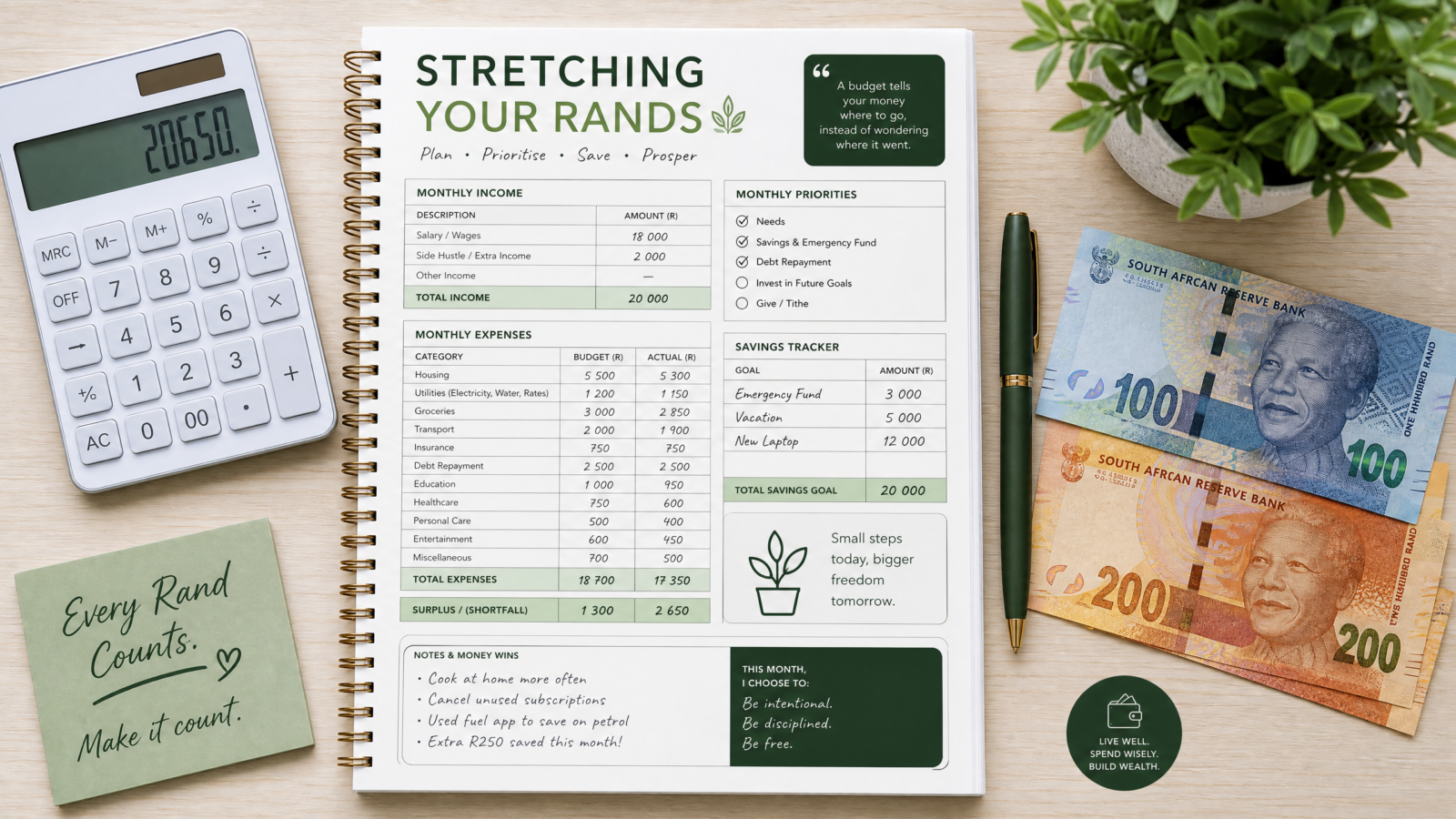
| May is almost done. And if you are sitting with the uncomfortable feeling that the money ran faster than the month — you are not alone. Between school fees, utility increases, fuel costs, and the quiet creep of everyday expenses, most South African households are doing more mental arithmetic than they should have to. Today’s post is not about guilt. It is not about a perfect spreadsheet. It is about something much more useful: a calm, practical approach to making your Rands stretch further — grounded in wisdom, not in panic. |
|---|
Why Budgeting Feels Hard — And Why That Is Not Your Fault
Let me say something that does not get said enough in personal finance spaces:
Budgeting is not hard because you are bad with money. Budgeting is hard because the system was not designed to make it easy for ordinary South African households.
Fuel levies. VAT at 15%. Load shedding and water shedding costs absorbed by households. Grocery inflation running above the headline CPI rate. An interest rate environment that has kept bond repayments elevated. These are structural pressures — not personal failures.
And yet, the advice most people receive is: spend less, save more, stop buying coffee.
That is not a budget strategy. That is a guilt trip wearing a spreadsheet.
A real budgeting approach starts with the truth of your actual situation — not a theoretical ideal — and builds from there with wisdom and intention.
“Be sure you know the condition of your flocks, give careful attention to your herds.” Proverbs 27:23 (NIV)
Know your numbers. Not because it is comfortable — it rarely is at first — but because you cannot steward what you have not counted. The Proverbs 31 woman knew her fields. She knew her household. She managed with precision and purpose.
That is the model we are working from today.
Step One: Know What Actually Comes In
Before you allocate a single rand, you need a clear picture of your real monthly income — not what you earn on paper, but what actually lands in your account after deductions.
For most employed South Africans this means: gross salary minus tax, UIF, pension fund contributions, and any other deductions your employer processes. That net figure is your real starting point.
If you have additional income — a side income, rental income, a commission, a once-off payment — include it only if it is consistent and confirmed. Do not budget on income you are hoping for. Budget on income you have received.
Write this number down. This is your foundation.
For the self-employed or variable-income earner: use your lowest consistent monthly income as your budget base. Any month you earn above that base is a surplus — which goes toward savings, debt, or your emergency fund. Budgeting on your best month and living at that level is how households get into trouble when an average month arrives.
Step Two: List Every Fixed Commitment First
Fixed expenses are the non-negotiables — the amounts that leave your account every month whether you like it or not. These come first in your budget because they are already decided.
Common fixed expenses for South African households:
- Tithe and giving commitments
- Bond or rental payment
- Car finance instalment
- Insurance (car, home, life)
- Medical aid contribution
- School fees (monthly debit order)
- Debt minimum repayments (personal loan, credit card, store accounts)
- DStv or streaming subscriptions
- Gym membership
- Internet / fibre
Write them all down. Every single one. Add them up.
Now subtract that total from your net income. What remains is your available income — the amount you have left to cover all variable expenses and savings before the month ends.
This number often surprises people. Some discover they have more flexibility than they thought. Many discover the opposite — that their fixed commitments have grown quietly over time until there is very little left for everything else.
Either way, you now know the truth. And the truth — as uncomfortable as it sometimes is — is always the better starting point.
Step Three: Prioritise Your Variable Expenses
Variable expenses are the ones that change month to month and require active management. This is where most budget conversations begin and end — but as you can see, we have not even arrived here yet. That is intentional. The foundation matters.
Your variable expense categories for a South African household typically look like this:
Groceries and household supplies This is usually the largest variable expense and the one with the most room for management. We will cover specific strategies for this below.
Fuel and transport Track this separately from groceries. Fuel costs are directly linked to your lifestyle patterns — work commute, school runs, weekend movement. Knowing your actual monthly fuel spend often reveals opportunities to consolidate trips, carpool, or reconfigure routines.
Electricity and water If you are on a prepaid meter, this is a variable you control. If you are on a municipal account, this varies with usage. Either way, track it. Winter months in South Africa drive electricity usage up significantly — a budget built in summer will need to be adjusted.
Children’s extras School events, stationery replenishments, sport fees, extramurals — these are easy to underestimate. Build a monthly buffer specifically for this category rather than absorbing it from groceries or other envelopes.
Personal care and clothing Needs versus wants live here. Budgeting honestly for this category — rather than pretending it does not exist — is what keeps budgets realistic and sustainable.
Entertainment and eating out This is not a category to eliminate. It is a category to be intentional about. A household with zero entertainment budget burns out and abandons the budget entirely. Give yourself a realistic amount and manage within it.
The Calm Budget Framework: Three Simple Envelopes
You do not need a complicated system. You need one that you will actually use. Here is the framework I propose for South African households — simple, practical, and grounded in how money actually behaves:
Envelope 1: Commitments (Fixed)
Everything from your fixed expense list. This leaves your account in the first few days of the month. You are not making decisions here — these are already decided. Your only job is to make sure the account is funded before the debit orders run.
Envelope 2: Living (Variable)
Groceries, fuel, electricity, children’s extras, personal care. Allocate a specific rand amount to each sub-category at the start of the month. Track your spending against these allocations weekly — not monthly. Weekly tracking catches overspending before it becomes a crisis.
A useful rule for groceries specifically: plan your meals for the week before you shop. A shopping list built from a meal plan consistently reduces the grocery bill by 15–25% for most households. Not because you are eating less — but because you are wasting less and buying deliberately rather than reactively.
Envelope 3: Forward (Savings and Debt)
This envelope is often treated as an afterthought — whatever is left at the end of the month. That approach almost never produces results.
Pay your Forward envelope on payday, alongside your fixed commitments. Automate the transfer before you spend. Even R200 toward your emergency fund. Even an extra R100 on a debt. The habit of paying forward first is more powerful than the amount, especially at the beginning.
“Dishonest money dwindles away, but whoever gathers money little by little makes it grow.” Proverbs 13:11 (NIV)
Little by little. Every month. With consistency. That is the model.
Practical Rand-Stretching Strategies for May (and Beyond)
Here are specific, actionable strategies that work within a South African context — not generic international advice, but things that are relevant to where we actually live and shop.
1. Shop with a list and a limit — not just a list A grocery list tells you what to buy. A limit tells you when to stop. Go to the store knowing your exact rand allocation for that trip. Use the calculator on your phone as you shop. This single habit closes more budget leakage than almost anything else.
2. Use loyalty programmes intentionally Woolworths Rewards, Pick n Pay Smart Shopper, Checkers Xtra Savings, Shoprite’s Xtra Savings — these are real money back on purchases you are making anyway. The trap is spending more to earn points. The strategy is earning points on your planned spend without changing what you buy.
3. Shift your shopping day Many South African supermarkets mark down near-expiry items later in the week and at the end of the month. Shopping on a Thursday or Friday for the following week often yields better deals than Monday or Tuesday shopping.
4. Batch your fuel stops Every time you make an unplanned trip, you spend fuel that was not in your budget. Consolidate errands. Combine school runs with grocery trips. Plan your week’s movement at the start of the week. This is one of the easiest places to recover R200–R400 a month without feeling any reduction in lifestyle.
5. Audit your debit orders every quarter Subscriptions accumulate quietly. A streaming service you added during a promotion. A gym membership you are not using. An insurance policy that renewed automatically at a higher premium. Set a quarterly reminder to review every debit order on your account and cancel anything that is not actively serving your household. This exercise typically finds R300–R800 in recoverable monthly spend for most households.
6. Cook once, eat twice (or three times) Batch cooking on a Sunday is one of the most underrated household budget strategies. A large pot of soup, a tray of roasted vegetables, a double portion of stew — these produce two to three meals for the work of one. Reduced take-out spend, reduced mid-week shopping trips, reduced food waste. The numbers add up quickly.
7. Negotiate, not just cancel Before you cancel a service, call and ask for a retention deal. DStv, insurance providers, internet service providers — retention teams often have access to discounts that are not advertised. A five-minute phone call has saved South African households hundreds of rands a month. Ask before you assume the price is final.
When the Budget Does Not Balance: What to Do
Sometimes you do the maths honestly and discover that your fixed commitments plus your essential variable expenses already exceed your income. This is a hard place to be — but it is not a hopeless one.
When the budget does not balance, there are only two levers available to you: reduce expenses or increase income. Usually, meaningful change requires both.
On the expense side: Look at your fixed commitments first, not your variable spending. A cancelled DStv subscription saves R1,000 a month. An insurance policy review can save R300–R500. A vehicle downgrade — while uncomfortable — can recover R2,000–R5,000 a month for households carrying expensive car finance. The variable expenses often have less room than people assume, because by the time most South Africans look at their variable budget, it is already lean.
On the income side: This is where the work we did earlier last week is directly relevant. Building a second income stream — even a modest one — changes the budget maths in ways that no amount of cutting can replicate. The Elevate Income Accelerator exists specifically for this: to help South Africans build an additional income stream from what they already have, starting at R99, with free tools and practical guidance every step of the way.
The budget gets easier when income grows. And income can grow — with the right structure and consistent action.
A Budget That Serves Your Values, Not Just Your Bills
I want to close with something that I believe separates a budget that lasts from one that lasts three weeks.
A budget that is purely about restriction is a budget that will be abandoned. We are not built for endless deprivation. Our households have life in them — children, celebrations, hospitality, rest. A budget that has no room for any of these is not a budget. It is a punishment plan. And punishment plans do not produce lasting change.
A budget that lasts is one that is aligned with your values. That has a line for what matters to your household. That is honest about your actual life, not an idealized version of it. And that leaves room — even small room — for the things that make the month feel like more than just surviving.
“She watches over the affairs of her household and does not eat the bread of idleness.” Proverbs 31:27 (NIV)
She watched. She was present. She was intentional. Not perfect — intentional.
That is what we are building toward. Not a flawless budget. An intentional one.
Start where you are. Use what you have. Make this month’s budget a little calmer than last month’s. Then do the same next month.
Faithful stewardship is not a single decision. It is a thousand small, consistent ones.
Reduce what you owe. Grow what you own.
Blessings & Abundance, Nomzamo Elevate Finance Partners
Ready to Stretch Your Income — Not Just Your Budget?
Sometimes stretching the Rands means more than cutting costs — it means building more. If you are ready to add an income stream that works around your current life, the Elevate Income Accelerator is your next step.
Four tiers. Starting at R99. Free tools only. Instant PDF delivery to your inbox. Faith-grounded and practically built for South Africans ready to grow what they own.
Explore all four EIA tiers here →
Or WhatsApp me directly on 073 509 8750 — I respond personally. Join Elevate Circle, our community for EIA members, and keep building with people who understand the journey.
Related Reads
- How to Build an Emergency Fund on a South African Salary
- How to Build a Second Income in South Africa (Without Burning Out)
- Make What You Have Work Harder
- How to Get Out of Debt — South Africa
Nomzamo Khosa is a financial educator — not a financial advisor. The content shared on Elevate Finance Partners is intended for general educational and informational purposes only and does not constitute financial, legal, or investment advice.
Leave a Reply