Nomzamo Khosa · Elevate Finance Partners · 11 June 2026 · 10 minute read
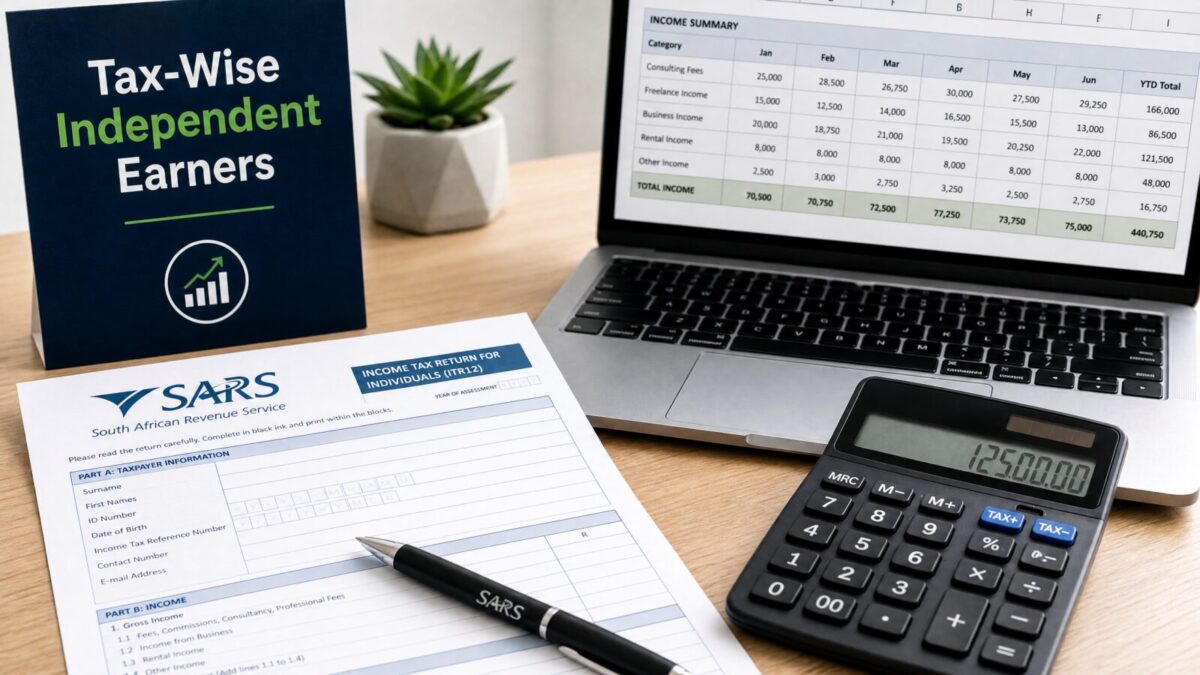
Essential SARS tax information for independent earners and digital entrepreneurs in South Africa — understand your tax return obligations, stay compliant, and steward your income with wisdom.
| Tax season 2026 is almost here. Auto-assessments begin rolling out on 1 July. Tax return filing opens on 13 July. And if you earn income from anything beyond a single employer — freelancing, digital products, commissions, rental income, a side business — this post is written specifically for you. Not to overwhelm you. Not to make tax feel more complicated than it needs to be. But because knowledge is protection, and an independent earner who understands their tax position is an independent earner who keeps more of what they build. |
|---|
A Personal Note from Nomzamo
We have spent the last few weeks in this space talking about building income beyond the paycheck. About multiple streams. About digital products, freelancing, affiliate commissions, and entrepreneurship.
And I want to make sure that as we build, we build wisely. Lawfully. With the same integrity that we bring to every other area of our financial lives.
Because here is something I have learned — both from my years in banking and from this entrepreneurial season I am currently in: income that is not properly accounted for is income that is not properly protected. SARS has more data, more enforcement capacity, and more digital tools than at any point in South Africa’s tax history. The era of hoping the taxman does not notice has passed.
But this is not a post about fear. It is a post about wisdom. About understanding the rules of the system clearly enough to navigate them with confidence — and to steward every rand you earn in a way that honours both the law and the God who entrusted you with the income in the first place.
“Give back to Caesar what is Caesar’s, and to God what is God’s.” Matthew 22:21 (NIV)
Taxes are not the enemy of wealth. Ignorance of taxes is. Let us close that gap today.
First: Understanding the 2026 SARS Tax Season Dates
Before anything else, let us put the key dates on the table — because the window is closer than most people think.
1 July 2026: Auto-assessments begin rolling out. SARS uses information from your employer, bank, medical aid, and retirement fund to automatically calculate your tax position. This process runs through to 12 July 2026.
13 July 2026: Filing season officially opens for non-provisional taxpayers. From this date you can submit your Income Tax Return (ITR12) through SARS eFiling or the SARS MobiApp.
23 October 2026: Deadline for non-provisional taxpayers — those who earn a regular salary or wage from an employer with PAYE already deducted.
22 January 2027: Deadline for provisional taxpayers and trusts. Provisional taxpayers are those who earn income beyond a salary — including rental income, freelance income, or business trading income.
This last category is where most independent earners and digital entrepreneurs fall. If you earn any income outside of a formal employer payroll, you are almost certainly a provisional taxpayer — and your deadline is January 2027, not October 2026.
Who Is a Provisional Taxpayer — And Are You One?
This is the question that most independent earners in South Africa either do not ask, or answer incorrectly.
A provisional taxpayer is any person who earns income that is not subject to PAYE — that is, income that is not deducted from a salary by an employer before it reaches you. This includes:
- Freelance income of any kind
- Digital product sales (PayHip, Gumroad, any platform)
- Affiliate commissions and referral income
- Rental income from a property
- Income from a side business or trading activity
- Commission income not processed through an employer’s payroll
- Income from content creation (YouTube monetisation, TikTok Creator Fund)
Any person is exempt from filing a tax return if their gross income consists solely of employment income not exceeding R500,000, with employees’ tax already deducted. If your income includes anything beyond that — any independent income at all — you are likely required to file, and likely qualify as a provisional taxpayer.
The practical implication: as a provisional taxpayer, you are required to submit two provisional tax returns per tax year (IRP6) — one by the end of August and one by the end of February — estimating your taxable income and paying tax in advance. This is in addition to your annual income tax return.
If this is new information to you, do not panic. Many South Africans who earn independent income are not aware of their provisional tax obligations — which is precisely why this post exists. The starting point is registering for provisional tax with SARS if you have not already done so.
The Auto-Assessment: What It Is and What to Do With It
An auto-assessment means SARS uses information received from employers, banks, retirement funds, medical schemes, and other third-party institutions to calculate your tax position automatically.
If you receive an auto-assessment, it is important to review it carefully to ensure that all income and deductions have been included correctly.
Here is the critical point for independent earners: SARS’s auto-assessment is only as complete as the information SARS already has. If you have earned income from digital platforms, freelance clients, or informal business activities that have not been reported to SARS by a third party — that income will not appear in your auto-assessment. And accepting an auto-assessment that excludes income you earned is not a win. It is a compliance risk.
Local tax experts remind us that we are under no obligation to blindly accept the auto-assessment offered by SARS. If you have earned independent income, review the auto-assessment carefully, add any income not already included, and file an amended or complete return.
You have 40 business days to review and either accept or file an amended return. Use that window wisely.
What Independent Earners Need to Declare
Let us be specific, because this is where many digital entrepreneurs and freelancers in South Africa are uncertain.
All income earned must be declared. This is not negotiable and it is not optional. It does not matter that the payment came through PayPal. It does not matter that the client paid you in cash. It does not matter that the digital platform does not issue you a tax certificate. Income is income — and income is taxable.
This includes:
Freelance and service income — Every rand you earn as a freelancer, consultant, tutor, designer, writer, or service provider is taxable income. If you invoiced a client and they paid you, that income is declarable.
Digital product sales — Revenue from products sold on PayHip, Gumroad, or any digital platform forms part of your taxable income for the year in which it was received.
Commission and affiliate income — Referral fees and affiliate commissions are income. Whether they arrive via bank transfer, PayPal, or any other method — they are declarable.
Content creation income — YouTube channel monetisation, TikTok Creator Fund payments, podcast sponsorships, and brand partnership fees are all taxable income.
Rental income — If you earn rental income from a property, this forms part of your taxable income. You may deduct allowable expenses against rental income — rates, levies, interest on the bond, maintenance — but the net rental income is taxable.
What You Can Deduct as an Independent Earner
This is the part of the tax conversation that most people miss — and it is where the wisdom lives.
As an independent earner, you may be entitled to claim certain business expenses against your income, which reduces your taxable amount. These deductions are legitimate, legal, and available to you — but they must be documented, and they must be genuinely related to your income-producing activities.
Common deductible expenses for digital entrepreneurs and freelancers:
Data and internet costs — If your work is primarily digital, a portion of your data and internet costs may be deductible. Keep your invoices.
Home office expenses — If you work from a dedicated home office space, a proportional amount of your rent or bond interest, electricity, and rates may be deductible. The space must be used regularly and exclusively for work — a kitchen table where you also eat does not qualify, but a dedicated room or workspace does.
Equipment and tools — Laptops, phones, ring lights, microphones, cameras — equipment purchased primarily for income-generating purposes may be deductible, subject to SARS’s depreciation rules.
Software and subscriptions — Canva Pro, editing software, email marketing platforms, accounting tools — subscriptions directly related to your work are potentially deductible. Keep your payment records.
Professional development — Courses, training, and educational materials directly related to your income-producing activity may be deductible.
Bank charges — Business-related banking fees are a legitimate deduction.
The golden rule for all deductions: keep your records. Invoices, receipts, bank statements, contracts. SARS does not require you to submit these with your return — but if you are audited, you will need to produce them. A good record-keeping habit now is your best protection later.
Registering for Tax as a First-Time Independent Earner
If you have recently started earning independent income and are not yet registered with SARS — this is your next step.
Tax registration in South Africa is free and can be done online:
Step 1: Register on SARS eFiling at efiling.sars.gov.za — you will need your South African ID number, contact details, and banking information.
Step 2: Once registered as a taxpayer, apply to register for provisional tax if your income includes any non-PAYE sources.
Step 3: Set up your record-keeping system before tax season opens. A simple spreadsheet tracking all income received and expenses incurred is a sufficient starting point.
Step 4: Consider working with a trusted accounting and compliance partner if your income situation is complex — particularly if you have multiple income sources, rental income, or business trading income. Cava Africa Solutions is a trusted South African accounting firm offering professional tax compliance, bookkeeping, and financial advisory services. If you are an independent earner or digital entrepreneur looking for reliable, professional support with your SARS obligations — they are a great starting point. TaxTim is also a well-known accessible platform for individual filers, and the SARS WhatsApp service (0800 00 7277) handles basic tax queries.
A Note on SARS’s Growing Enforcement Capacity
I want to name this directly — because it is relevant and it would be irresponsible not to.
SARS has increased enforcement efforts under initiatives such as Project AmaBillions, with a stronger focus on closing revenue gaps and improving compliance. More queries, more verifications, and more audits are already filtering through.
SARS has access to banking data, payment platform data, and third-party financial information at a scale that has never existed before. The assumption that small independent income goes unnoticed is increasingly untrue — and the penalties for non-compliance are significant. These include interest on unpaid tax, administrative penalties, and in serious cases, criminal prosecution.
This is not shared to create fear. It is shared because the most financially empowered position available to any independent earner is full compliance — not because they have to be, but because they have chosen to build something that lasts. Something that does not carry the risk of being dismantled by a SARS audit three years from now.
Faithful stewardship includes fiscal responsibility. What belongs to Caesar, goes to Caesar — honestly, accurately, on time.
Your Tax Season 2026 Action Checklist
Here is a practical, step-by-step checklist to carry you from today to the filing window with confidence:
Now (June 2026):
- Gather all IRP5 certificates from your employer(s)
- Compile a record of all independent income earned from 1 March 2025 to 28 February 2026
- Gather receipts and records for all deductible business expenses
- Confirm your eFiling login is active and your banking details are current
- Register for provisional tax if you have not already done so
July 2026:
- Review your auto-assessment (from 1 July) carefully — do not accept blindly
- File your ITR12 from 13 July — do not wait until October
- If your situation is complex, engage a registered tax practitioner early
Ongoing:
- Set up a simple income and expense tracker for the 2026/2027 tax year starting 1 March 2026
- Keep all receipts and invoices — digital copies are acceptable
- Set a reminder for your first provisional tax return (IRP6) due end of August 2026
The Bigger Picture: Tax as Stewardship
I want to close with something that I believe is important in this community.
Paying tax is not a punishment for success. It is a participation in a system that — imperfectly, and with many areas for improvement — funds the roads, schools, hospitals, and public infrastructure that every South African uses.
More personally: building a financial life that is fully above board — where every rand earned is declared, every obligation is met, and every deduction is legitimate — is a foundation of peace. There is no audit anxiety. There is no avoidance strategy to maintain. There is simply a clean, compliant, growing financial life that can be spoken about openly.
“Whoever can be trusted with very little can also be trusted with much.” Luke 16:10 (NIV)
Trustworthiness with small amounts of independent income builds the character and the systems for larger amounts. Do not wait until the income is significant to take your tax obligations seriously. Build the habit now. Let the system grow with you.
Tax-wise is not the same as tax-clever. It is not about finding loopholes or minimising what you owe through creative accounting. It is about knowing what you owe, paying it faithfully, claiming what is legitimately yours, and building something that lasts because it was built on solid ground.
That is faithful stewardship. And it is available to you right now, this June, before tax season opens.
If you would like to read more about building a financial life that goes beyond the numbers — with integrity and purpose at the centre — the story of Nompilo Gumede on living beyond the balance sheet is one worth sitting with.
Reduce what you owe. Grow what you own.
Blessings & Abundance,
Nomzamo
Elevate Finance Partners
Ready to Build the Income Worth Declaring?
If today’s post has given you clarity on your tax obligations — and you are ready to build the independent income streams that make this all relevant — the Elevate Income Accelerator is your next step.
Four tiers. Starting at R99. Free tools only. Instant PDF delivery. 100% commission on every sale you generate.
Explore all four EIA tiers here →
Or WhatsApp directly on 073 509 8750 — I respond personally. Every EIA member joins Elevate Circle, our community where the building continues together.
Related Reads
- Beyond the Paycheck: How to Build Multiple Income Streams in South Africa for Lasting Wealth
- How to Make Money Online in South Africa as a Young Person in 2026
- How to Build a Second Income in South Africa (Without Burning Out)
- How to Stretch Your Rands: A Calm, Faith-Grounded Guide for SA Households
Nomzamo Khosa is a financial educator — not a financial advisor. The content shared on Elevate Finance Partners is intended for general educational and informational purposes only and does not constitute financial, legal, or investment advice. For personalised tax guidance, consult a registered tax practitioner or visit sars.gov.za.
Leave a Reply