Nomzamo Khosa · Elevate Finance Partners · 30 June 2026 · 9 minute read
Take control of your finances with a mid-year reset check-up. Our guide helps South Africans review progress, set new goals, and plan for financial success.
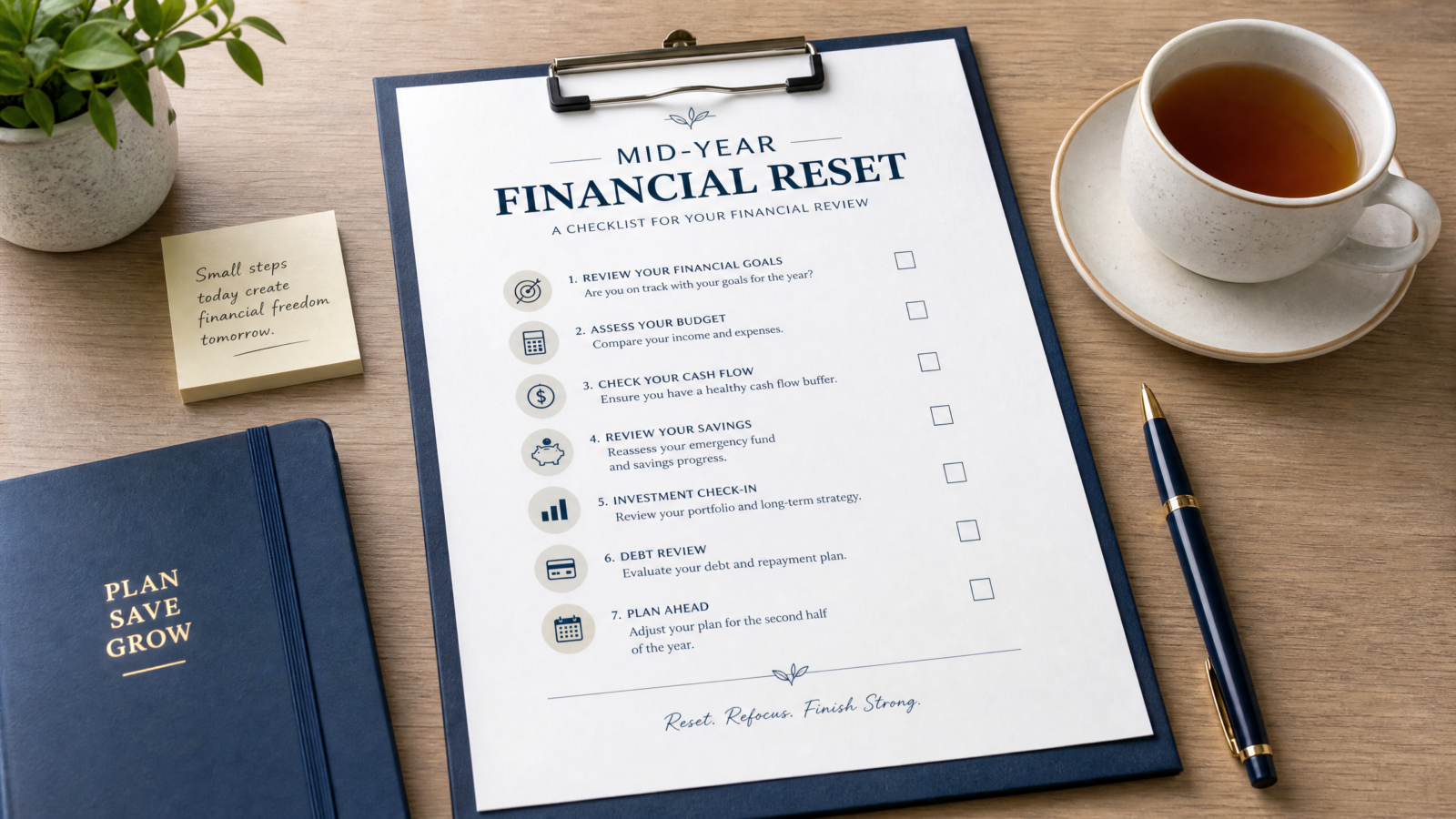
| Six months. That is what we have just walked through together. And today — the last week of June, the exact midpoint of 2026 — is not a week to rush past on the way to July. It is a week to stop, look back honestly, and look forward with intention. This is your mid-year reset. Not a New Year’s resolution redo. A real, practical, faith-grounded check-up on where you actually stand. |
|---|
A Personal Note from Nomzamo
What a month this has been.
We started June honouring young South Africans and the digital skills available to this generation. We walked through six ways to earn a first digital income. We talked about the urgency of diversifying beyond a single paycheck. We faced our SARS obligations honestly, ahead of the July filing window. We celebrated Youth Day and the spirit of 1976 carried into 2026. We revisited the widow’s jar of oil and the journey from debt to destiny. And just this week, we unpacked the newly expanded TFSA and what it means for building generational wealth.
That is a lot of ground covered. And if you have walked through even some of it with me — read, reflected, taken one action, started one habit — I want you to pause today and acknowledge that.
But today is not about looking back at the content. Today is about looking back at your own numbers. Your own decisions. Your own season.
The midpoint of the year is a gift that most people let pass by unused. We are conditioned to treat January as the only legitimate time for financial reflection — as if the first of January carries some magic that the thirtieth of June does not. It does not. Every six months is a legitimate checkpoint. Every six months deserves an honest look.
“Plans fail for lack of counsel, but with many advisers they succeed.” Proverbs 15:22 (NIV)
Today, let your own honest reflection be the counsel you give yourself.
Why the Mid-Year Reset Matters More Than People Realise
January resolutions are made with hope and very little information. You do not yet know how the year will unfold — what expenses will surprise you, what income opportunities will emerge, what the actual cost of living will do to your budget by April or May.
By the end of June, you have six real months of data. Six months of actual spending patterns. Six months of actual income received. Six months of evidence about which goals you pursued with consistency and which quietly fell away.
This is far more valuable than a January resolution, because it is grounded in reality rather than hope. A mid-year reset is not about starting over. It is about course-correcting with real information in hand — adjusting the plan based on what the first half of the year has actually taught you about your finances, your habits, and your capacity.
This is stewardship in its most practical form: regularly examining what has been entrusted to you, honestly, so that the second half of the stewardship period is wiser than the first.
Step One: The Honest Financial Review
Before any new goal-setting, we look back. Honestly, without judgment, but without avoidance either.
Review your income. What did you actually earn over the first six months of 2026 — salary, side income, any digital income streams you have started building this month? Is it more, less, or the same as you projected in January? If you started a second income stream this month following our posts on digital skills and diversification — where does it currently stand?
Review your spending. Pull your bank statements for January through June. Categorise the spending honestly. Where did the money actually go, compared to where you intended it to go? Most people are surprised by at least one category — usually food delivery, subscriptions, or impulse retail spending that accumulated quietly across six months.
Review your debt position. If you set a debt repayment goal in January, or began one following our recent posts on faith-based debt freedom, where do the numbers actually stand today compared to where they stood on 1 January? Has the balance moved in the right direction? By how much?
Review your savings and investments. Did you open the TFSA we discussed on Tuesday? Did you build or maintain an emergency fund? What is the actual rand value sitting in savings today compared to six months ago?
Review your giving. For households in this community who hold tithe and giving as a first-fruits commitment, has that commitment been honoured consistently across six months, or has it been the first casualty when money felt tight?
Write all of this down. Real numbers, not impressions. The honest review is uncomfortable for almost everyone — but it is also the single most valuable exercise in this entire post.
Step Two: Celebrate What Actually Worked
This step is frequently skipped, and it should not be. Before you move into correction and adjustment, take a genuine moment to acknowledge what went right in the first half of 2026.
Did you stick to a budget for even three of the past six months? That is real progress — celebrate it. Did your emergency fund grow, even modestly? That deserves acknowledgment. Did you start a side income stream, even if it has not yet produced significant income? That courage matters, regardless of the current rand value.
“Well done, good and faithful servant! You have been faithful with a few things; I will put you in charge of many things.” Matthew 25:21 (NIV)
Faithfulness with small things precedes responsibility for larger things. If you have been faithful with small, consistent financial actions over the first half of this year — even imperfectly — that faithfulness is building something, even if the visible results still feel modest.
Do not let the gap between where you are and where you want to be erase the genuine progress that exists in between.
Step Three: Name What Did Not Work — Without Shame
Now, the harder part. What did not go according to plan in the first six months?
Maybe the budget held for January and February and then quietly dissolved by March. Maybe the emergency fund contribution stopped the moment an unexpected expense arrived. Maybe the side income idea never actually launched, despite genuine intention. Maybe debt increased rather than decreased, for reasons that felt outside your control at the time.
Name these things specifically and honestly. But — and this matters as much as the honesty itself — name them without shame.
Shame is not a strategy. It does not produce better outcomes. It simply adds emotional weight to a situation that already requires clear thinking. The goal of this step is diagnostic, not punitive: understanding specifically why a plan did not hold, so that the adjustment you make for the second half of the year addresses the actual cause rather than repeating the same well-intentioned but unworkable approach.
Ask yourself honestly: Was the goal unrealistic given my actual income? Did an unexpected life event disrupt the plan? Did I lack a specific tool or system that would have made consistency easier? Did I simply lose motivation without a clear reason?
The answer to that question shapes what needs to change for July through December.
Step Four: Set Your July–December Financial Priorities
With an honest review complete, it is time to set direction for the second half of the year. I recommend choosing no more than three priorities — more than that, and focus dilutes across too many fronts to make meaningful progress on any of them.
Consider these categories, drawn directly from what we have built together this year:
Income. If you started a digital income stream this month, what does scaling it look like for the rest of 2026? If you have not yet started one, is the second half of this year the season to begin — using the frameworks from our posts on digital skills and income diversification?
Debt. If you are mid-journey on a debt repayment plan, what is the realistic target balance by 31 December? Using the snowball or avalanche method we outlined, what extra monthly payment is achievable for the second half of the year?
Savings and Investment. Have you opened your TFSA following Tuesday’s post? If not, this is the moment. If you have, what monthly contribution — even starting modestly — can you commit to for July through December, working toward the new R46,000 annual limit over time?
Tax Compliance. With SARS filing season opening on 13 July, is your independent income properly recorded and ready for filing? If you are a provisional taxpayer, is your first IRP6 return for August on your calendar?
Giving and Stewardship. Is your tithe and giving commitment structured at the top of your budget, ahead of every other expense, for the second half of the year?
Choose your three. Write them down with specific, measurable targets — not “save more,” but “contribute R500 monthly to my TFSA from July to December.” Specificity is what separates an intention from a plan.
Step Five: Build Your Mid-Year Accountability System
A plan without an accountability structure quietly fades by August. Here is how to protect the priorities you have just set.
Set a calendar reminder for a 90-day check-in — 30 September — to review progress against your three priorities. Do not wait until December to discover whether the plan held.
Share your priorities with someone. We talked about the unseen ROI of a support system earlier this year — this is exactly the moment to activate it. Tell your spouse, a trusted friend, or your Elevate Circle community what you are committing to for the second half of the year. Spoken commitments are honoured more consistently than private ones.
Automate what you can. Every priority that can be automated — a TFSA debit order, an extra debt payment, a savings transfer — should be automated on payday, before discretionary spending has the chance to compete for the same rand.
Track monthly, not just at year-end. A simple monthly check — five minutes, on the same date each month — comparing actual progress against your three priorities, keeps the plan alive in your awareness rather than forgotten until the next major checkpoint.
A Mid-Year Prayer of Reset
I want to close this post, and this month, with something a little different — a prayer of reset for the second half of this year, for any reader who wants to pray it as their own.
Lord, thank You for the first six months of this year — for the lessons learned, the progress made, and even the setbacks that taught me something I needed to know. I bring my finances honestly before You today, without shame and without excuse. Where I have been faithful, I thank You. Where I have fallen short, I ask for wisdom to do better in the second half of this year. Help me to steward what You have entrusted to me with diligence, consistency, and faith. Let the next six months be marked by intentional growth, generous giving, and peace that surpasses the size of any number on a page. In Jesus’ name, amen.
Your Second Half Starts Today
We have built a lot together this June — digital skills, income diversification, tax compliance, Youth Day reflection, the journey from debt to destiny, and the power of the TFSA. Today’s post brings it all together into one practical action: a real, honest, faith-grounded mid-year reset.
You do not need to have the second half of 2026 figured out perfectly today. You need three clear priorities, an honest account of where you stand, and the willingness to keep going with the same faith and consistency we have talked about all year.
Six months down. Six to go. Let’s build them well.
Reduce what you owe. Grow what you own.
Blessings & Abundance,
Nomzamo
Elevate Finance Partners
Build the Second Half With a Structured Roadmap
If today’s reset has revealed that income growth is one of your top three priorities for the rest of 2026, the Elevate Income Accelerator remains the structured starting point. Four tiers, beginning at R99, with free tools and a practical roadmap built for exactly this season.
Explore all four EIA tiers here →
Or WhatsApp directly on 073 509 8750 — every EIA member joins Elevate Circle, our community of accountability for the second half of this year.
For tax compliance as you head into the second half of 2026, Cava Africa Solutions offers trusted, professional guidance for South Africans.
Related Reads
- The TFSA Edge: How to Build Tax-Free Family Wealth in South Africa in 2026
- Debt to Destiny: Your Freedom Journey
- Beyond the Paycheck: How to Build Multiple Income Streams in South Africa for Lasting Wealth
- How to File Your Tax Return as a Freelancer or Independent Earner in South Africa
Nomzamo Khosa is a financial educator — not a financial advisor. The content shared on Elevate Finance Partners is intended for general educational and informational purposes only and does not constitute financial, legal, or investment advice.
Leave a Reply